Playground artificial grass in Miami-Dade is bought by schools, daycare centres, churches, parks departments and parents turning a back garden into a play area. The build differs from a lawn in one fundamental way: the surface has a fall-height rating that depends on the shock-absorbing layer underneath, so the turf cannot be chosen until the equipment height and the required critical fall height are known. Published South Florida bands put sports and play surfaces at 15 to 20 per square foot for material and 12 to 15 per square foot for labour, above a standard landscape lawn, because the pad, the base and the edge detail all cost more.
Fall height comes before product choice
The sequence is fixed. Measure the highest designated play surface on the equipment, decide the critical fall height the surface must meet, then choose a shock pad and a turf plus infill combination that carries that rating together. A turf sold as playground grass without a pad under it is a lawn. Ask any installer for the pad specification and the tested fall height of the assembled system, not the number printed on the turf roll.
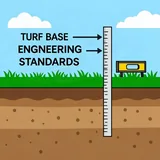
The base under a play surface in Miami
Miami-Dade sits on oolitic limestone under a thin layer of sandy fill, and the Krome series mapped across the county is a very gravelly loam that drains very fast (https://soilseries.sc.egov.usda.gov/OSD_Docs/K/Krome.html, HTTP 200). Play areas still need a designed base: a compacted, open-graded aggregate layer with a geotextile separator and a graded fall to an outlet. The wet season runs roughly May to October with short heavy downpours (https://www.weather.gov/mfl/, HTTP 200), and a play surface that ponds is unusable for days and unsafe under a slide.
What a playground install costs
- Material, 15 to 20 per square foot in the published South Florida sports and play band.
- Labour, 12 to 15 per square foot, above landscape rates because of the pad, base and edge detail.
- Shock pad priced by the required fall height and thickness, and quoted separately so you can compare it.
- Base, edging and drainage, 1 to 3 per square foot each, as on any lawn build.
A playground is usually a smaller area than a lawn, so the fixed costs spread over fewer square feet. Expect the installed price per square foot to sit at the top of the published band, and expect the pad to be the line that moves it most.
Heat, hygiene and shade
A synthetic play surface in full Miami sun runs well above air temperature, and published measurements put dark-infill surfaces in the 140 to 160 F range on a hot day. Shade from planting or a canopy, lighter infill and a hose-down before the afternoon session are the practical controls. Hygiene matters as much as heat in a humid market: the surface must drain so it can be washed, and a school or daycare should have a written rinse and sanitising routine that the installer accounts for in the drainage design.
Purchasing for a school or a public body
Public and institutional buyers need three documents before award: the assembled system specification with the tested fall height, the drainage plan showing the outlet, and the maintenance schedule the owner will actually run. Add the wind detail, because a Miami-Dade play area is inside the hurricane wind zone and perimeter anchoring is part of the specification, not an option. Requests from institutions are matched to installers who have completed padded play surfaces, not to lawn-only crews.
Frequently asked questions
Does playground artificial grass need a shock pad?
If the surface has to meet a critical fall height, yes. The pad and the turf work as one tested system. Ask for the assembled rating rather than the figure printed on the turf.
What does a playground surface cost in Miami?
Published South Florida bands put sports and play material at 15 to 20 per square foot and labour at 12 to 15 per square foot, both above landscape rates. The shock pad is priced by required fall height and quoted separately.
Will the surface be too hot for children in summer?
A dark-infill synthetic surface in full sun can reach the 140 to 160 F range on a hot day. Use lighter infill, add shade where the equipment allows, and hose the surface before afternoon use.
Can a school get quotes through this service?
Yes. Describe the equipment, the required fall height and the area, and the request goes to installers who have built padded play surfaces in Miami-Dade.
Related
Sources
- InstallArtificial - artificial grass prices in Miami
- Monster Grass South Florida - cost to install turf in Miami
- Synthetic Grass Warehouse Florida - Miami artificial grass cost page
- National Weather Service Miami-South Florida - wet season and hurricane season
- USDA-NRCS Krome series - the soil mapped across Miami-Dade
- Florida Statutes s. 373.185 - Florida-friendly landscaping and association rules
- Sunshine 811 - Florida one-call notice before digging