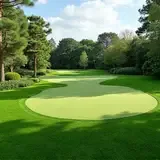
An artificial putting green in Miami is a small area with a large specification: a shaped, compacted base, a cup liner or a synthetic cup system, a fringe or chipping collar, and a turf with a low face weight and a tight stitch so the ball rolls at a consistent speed. Published South Florida bands put putting green material at 12 to 16 per square foot and labour at 15 to 20 per square foot, the highest per-square-foot prices on this site, because the area is small, the base has to be shaped rather than flattened, and the tolerance for error is measured in millimetres.
What it costs in Kendall
| Job | Published 2026 range |
|---|---|
| Removal of the existing lawn and debris hauling, added to the installation | 1 - 3 per square foot |
| Excavation and a compacted crushed-rock base, added to the installation | 1 - 3 per square foot |
| Class II road base aggregate | $42 per ton |
| Washed open-graded drainage stone | $52 per ton |
| Non-woven geotextile soil separator placed under the base | $0.48 per square foot |
| Basic grass with silica sand infill, per square foot installed | $9.30 per square foot |
| Rapid-drain grass with zeolite infill, per square foot installed | $12.60 per square foot |
| Standard installation labour | $8.50 per square foot |
| Pet-spec installation labour, deeper dig and edge pinning | $11.50 per square foot |
| Hurricane-rated edge pinning and seam anchoring, where specified | 1 - 2 per square foot |
| Permit allowance, where the jurisdiction requires one | 100 - 500 |
| Spot repairs and small fixes | a few hundred to several thousand depending on scope |
The base is the green
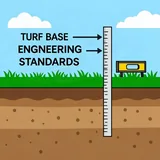
A lawn base can be flat. A green cannot: contours, breaks and a shaped apron are the point of it. The build compacts an open-graded aggregate in shaped lifts, checks the surface with a straight edge and a level, and only then lays the turf and cuts the cups. In Miami-Dade the rock is often shallow, so the shape is built up rather than excavated, and the same base has to carry away wet-season rain without turning the low side into a puddle.
What a green costs in Miami
- Material, 12 to 16 per square foot in the published South Florida putting green band.
- Labour, 15 to 20 per square foot, the highest labour band in the market because of shaping and cup work.
- Fringe or chipping collar priced by the running foot or square foot, and worth quoting separately.
- Base and drainage, as with any build, plus the cup system.
Most backyard greens run 200 to 600 square feet. Because fixed costs spread over a small area, the per-square-foot price is not comparable to a lawn quote, and a green that seems cheap per square foot is usually a flat pad with turf on it.
Turf choice for a Miami green
Putting turf is a short pile with a tight stitch and a low face weight, usually polypropylene or a nylon blend, and it is chosen for roll consistency rather than for looks. Infill is fine silica sand, brushed in to weight the surface and set the speed. In South Florida add ultraviolet to the checklist: everything at 8 and above on the EPA UV Index scale is very high to extreme and Miami sits there much of the year (https://www.epa.gov/sunsafety/uv-index-scale-0, HTTP 200), so a stabilised fibre is not a premium, it is the minimum.
Local note for Kendall
The county is mapped on oolitic Miami Limestone, a soft, highly permeable rock that is often within a metre of the surface under a thin layer of sandy fill. The USDA-NRCS Krome series, mapped across Miami-Dade, is a very gravelly loam over limestone that drains very fast (https://soilseries.sc.egov.usda.gov/OSD_Docs/K/Krome.html, HTTP 200). Crews hit rock quickly, so a turf build usually goes up rather than down: a graded, compacted open-graded aggregate base over a geotextile separator, with a positive drainage outlet. Parts of Kendall carry canal frontage and seasonal high water, so the outlet for a turf base often runs to a swale or a canal rather than into the ground.
Kendall is an unincorporated Miami-Dade community served by WASD for water and sewer. Because it is unincorporated, permits and code enforcement come from the county rather than a city hall.
Utility accounts: Miami-Dade Water and Sewer Department (WASD) · 305-665-7477
Checking a quote in Kendall
- How deep will you excavate, and is that depth stated in the contract with the aggregate type?
- Which base material is specified, and does the design drain the yard during a summer downpour or hold water against the house?
- What compaction target do you build to, and how do you verify it before the grass goes down?
- How is the turf anchored for wind, and what uplift or wind rating does the manufacturer publish for the product you are quoting?
- Is removal of the old lawn, the sprinkler capping and the debris disposal inside the quote or billed separately?
- What infill are you using, how many pounds per square foot, and is the seam and workmanship warranty separate from the manufacturer warranty?
Frequently asked questions
What does a putting green cost in Miami?
Published South Florida bands put putting green material at 12 to 16 per square foot and labour at 15 to 20 per square foot, the highest per-square-foot bands on this site. Most backyard greens run 200 to 600 square feet.
How long does a putting green take to install?
Usually a week or two for a backyard green. The shaping and compaction of the base is the slow part, and the turf and cups go in quickly after that.
Will the green drain in Miami rain?
It will if the apron is graded and the base is open-graded with an outlet. A green built flat on compacted fill holds water at the low break, and that is where cups silt and the surface goes soft.